Republicans seek to eliminate Empower charge, but plan meets resistance
The Debate Over Repealing the EmPOWER Maryland Surcharge
A recent legislative session in Maryland saw a bill aimed at repealing the EmPOWER Maryland surcharge brought before the House Environment and Transportation Committee. This proposal has sparked a heated debate among lawmakers, with some arguing that it would provide much-needed relief to ratepayers, while others believe the program has delivered significant benefits through energy efficiency initiatives.
Delegate Brian Chisholm, a Republican supporting the measure, emphasized the need for immediate action. "We need to provide some real relief to our rate payers. That's what this bill aims to do," he stated during the hearing. According to Chisholm, the bill would achieve three main objectives: stop the EmPOWER program immediately, halt the surcharge, and pay off the program's outstanding debt.
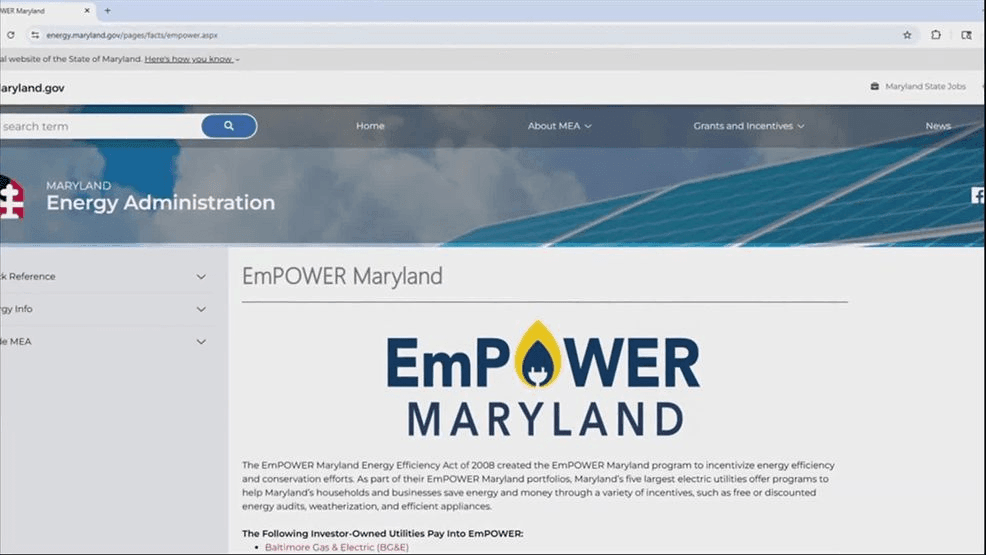
The EmPOWER Maryland Energy Efficiency Act was enacted in 2008 with the goal of reducing electricity consumption. During the hearing, Chisholm criticized the financial arrangement that underpins the program. "What they did is said, listen, we're to go to the utilities. We're going to ask the utilities to pay for a lot of this, all these benefits up front to the tune of 800 million to a billion dollars, we're going to pay you 9% interest. I don't know how they got that deal, but that is the greatest deal going," he remarked.
He further argued that the current structure of the program has allowed utility companies to benefit significantly, while ratepayers have been bearing the cost for nearly 15 to 20 years. "That needs to be paid off immediately," he added.
The EmPOWER fee varies depending on usage and can range from about $20 to over $100 on individual bills. While some lawmakers see this as an unnecessary burden, others highlight the program’s long-term savings.
Delegate David Fraser-Hidalgo, a supporter of the program, pointed out that "there's a lot of talk about how much EmPOWER costs, but there doesn't seem to be a whole lot of talk about how much money EmPOWER saves." An advocate from the Sierra Club echoed this sentiment, stating that the program has saved $15.8 billion in lifetime savings compared to a cost of $4.6 billion.
Despite these arguments, the fiscal note accompanying the bill indicates that repealing the surcharge would not significantly impact ratepayers. "Although the bill repeals the EmPOWER surcharge, it does not repeal the EmPOWER Maryland Program itself," the note explained. It also suggested that the Public Service Commission (PSC) may replace the surcharge with an alternative funding mechanism, which could include base rate proceedings or a new surcharge. The overall effect on electricity and gas prices is expected to be minimal.
Chisholm acknowledged that the bill includes provisions allowing utilities to continue voluntary energy efficiency efforts without funding. "If the utilities would like to do something on a voluntary basis, they may continue to do that, but we would stop all programs going forward without any funding," he said.
This is not the first time a bill related to the EmPOWER charge has been introduced. A similar effort last year failed to gain traction, highlighting the ongoing challenges in addressing this issue.


