North Korea Launches Ballistic Missiles toward Sea of Japan in 2026 Test
North Korea Launches Ballistic Missiles Amid Diplomatic Tensions
North Korea has launched multiple ballistic missiles off its east coast, targeting the Sea of Japan. This event was reported by South Korea's military and marks the country's first missile launch of the year. The incident occurred just hours before South Korean President Lee Jae Myung was set to depart for a summit in China.
The missile launches are seen as a significant show of force from Pyongyang. This action follows a recent US military operation that led to the capture of Venezuelan President Nicolas Maduro. For many years, this scenario has been a major concern for North Korea's leadership, which has consistently accused the United States of seeking to remove it from power.
South Korea's defense ministry confirmed the detection of "several projectiles, presumed to be ballistic missiles" fired from near the North Korean capital, Pyongyang, around 7:50 am (2250 GMT Saturday). According to the military, the missiles traveled approximately 900 kilometers (559.2 miles). Both South Korea and the United States are currently analyzing the specifications of the missiles while maintaining a full readiness posture.
An emergency meeting was held by the National Security Council in Seoul following the launch. A presidential office statement described the act as "a provocative act in violation of United Nations Security Council resolutions."
Japan's defense ministry also detected a possible ballistic missile. They noted that two of the missiles reached an altitude of 50 kilometers and flew distances of 900 and 950 kilometers respectively. Japanese Defense Minister Shinjiro Koizumi expressed concerns, stating that North Korea's nuclear and missile development poses a threat to the peace and stability of the country and the international community.
This is the first ballistic missile launch by Pyongyang since November, when it conducted a test after US President Donald Trump approved South Korea's plan to build a nuclear-powered submarine.
Analysts Link Missile Launch to Recent US Actions
One analyst suggested that the US military operation against Venezuela on Saturday might have influenced North Korea's decision to conduct the launch. For decades, Pyongyang has maintained that its nuclear and missile programs serve as a deterrent against alleged regime change efforts by Washington. The United States has repeatedly assured Pyongyang that it has no such plans.
Hong Min, an analyst at the Korea Institute for National Unification, stated, "They likely fear that if the United States so chooses, it could launch a precision strike at any moment, threatening the regime's survival." He added, "The underlying message is likely that attacking North Korea would not be as easy as a strike on Venezuela."
A former senior North Korean diplomat, Lee Il-kyu, who defected to South Korea in 2023, commented on the situation. He said, "I hope it remembers former president Maduro for a long time -- as a man who squandered a valuable opportunity through bluster."
South Korean President Heads to China
The missile test occurred just hours before South Korean President Lee Jae Myung was scheduled to leave for Beijing for talks with Chinese President Xi Jinping. China plays a significant role as an economic backer of North Korea, and Lee hopes to leverage this relationship to improve ties with Pyongyang.
In recent years, North Korea has significantly increased its missile testing. Analysts believe this drive is aimed at enhancing precision strike capabilities, challenging the United States and South Korea, and potentially exporting weapons to Russia.
Pyongyang is also preparing for a landmark congress of its ruling party, which will be the first in five years. Economic policy, along with defense and military planning, is expected to be high on the agenda.
Expansion of Missile Production
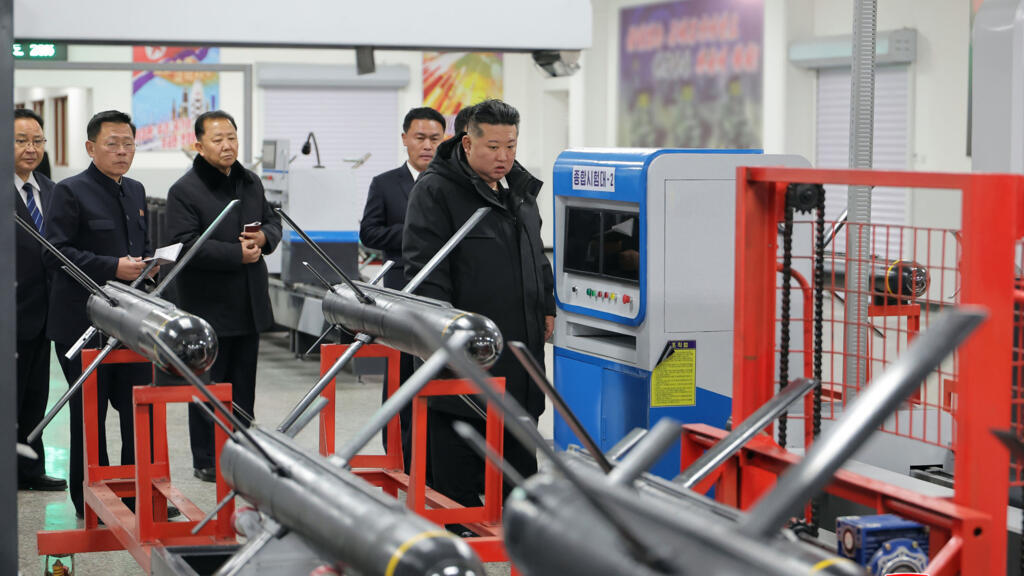
Ahead of the congress, North Korean leader Kim Jong Un ordered the expansion and modernization of the country's missile production and the construction of more factories to meet growing demand. State media reported that Kim visited a facility involved in making tactical guided weapons. He instructed them to expand current production capacity by 250 percent, according to the state-run Korean Central News Agency.


